
Online Casinos in Germany 2026
Germany operates one of Europe’s most strictly regulated online gambling markets, overseen by the GGL (Gemeinsame Glücksspielbehörde der Länder). Our team has tested and reviewed dozens of gaming platforms in Germany to help you navigate this competitive market. In this article updated for 2026 by the Nightrush editorial team, you’ll find insights from our team on regulations like the 2021 State Treaty, payment methods, tax rules, casino bonuses, and responsible gaming practices when playing at the best online casinos.

Online Casinos with German Language 2026
Our team selected some online casinos based on game variety, German language support, and bonus transparency. While these online casinos are not GGL-licensed, they hold licences from international authorities such as Curaçao and PAGCOR. Please be aware that playing at non-GGL-licensed casinos falls outside Germany’s regulated framework.
| Casino | Licence | Bonus | German Language Support | Total Game Numbers |
|---|---|---|---|---|
| Hugo | Curaçao | 225% up to €600 + 275 Free Spins | ✅ | 10,000+ |
| GlitchSpin | Curaçao | 220% up to €2200 + 100 Free Spins | ✅ | 7,900+ |
| Koru | Curacao | 350% up to €15,000 + 350 Free Spins | ✅ | 10,000+ |
| Betista | Curaçao | 370% up to €3700 + 100 Free Spins | ✅ | 2,000+ |
Warning: Bonus terms and limits may differ from GGL regulations. Always check individual casino terms.
Note: PAGCOR is the Philippine Amusement and Gaming Corporation. PAGCOR-licensed casinos operate outside the European regulatory framework and offer different levels of player protection compared to MGA or UKGC-licensed platforms.
Key Milestones of Gambling in Germany
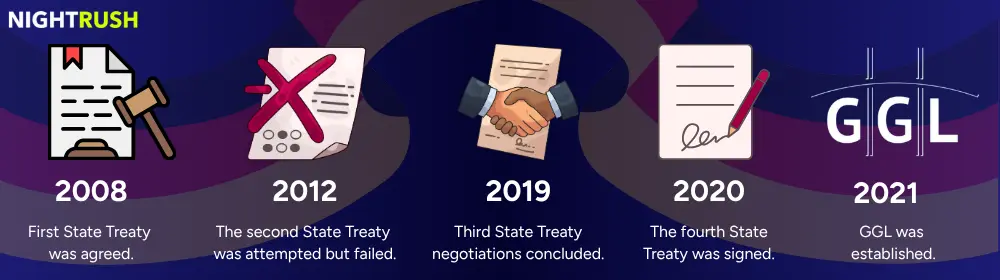
Gambling regulation in Germany evolved significantly, from a fragmented state-by-state system in the early 2000s to a unified national framework in 2021:
- 2008 – The first nationwide State Treaty on gambling was agreed upon, covering lotteries, casinos, and sports betting.
- 2011 – The first State Treaty expired.
- 2012 – The second State Treaty was attempted but failed, leading to a prolonged period where many international operators accepted German players under European licences, like with the MGA, effectively leaving the market in limbo and fostering a substantial and unregulated black market.
- 2019 – Third State Treaty negotiations concluded, leading to the fourth treaty.
- 2020 – The fourth State Treaty was signed by all 16 German states.
- 2021 – The fourth State Treaty came into effect on July 1, 2021, creating a uniform regulatory framework and encouraging players to use licensed online casinos. GGL was established.
- 2023 – GGL began active enforcement.
In our experience reviewing German casinos, the shift post-2021 has been significant; the market is noticeably more structured and player-focused than before.
Key Factors of Online Gambling in Germany
Germany’s Gambling Market Is One of the Largest in Europe
Germany stands as one of the largest gambling markets in Europe. Germany’s online gambling market has been growing rapidly, generating a revenue of €14.4 billion in 2024. This growth is driven by high smartphone penetration, a strong economy, and increasing player preference for regulated online platforms.
Over a Third of Germans Gambled in 2025
According to the German Gambling Survey 2025, up to 36.4% of respondents in Germany reported gambling within the past year. Participation was higher among men (40.4%) than women (32.4%), and it generally increased with age, reaching its highest level in the 56–70 age group (40.3%).
Most European Players, Including Germans, Gamble on Mobile Devices
Smartphones have accelerated the adoption of mobile casinos and gambling sites, with 54% of bets in Europe now being placed on smart devices, according to the Online Gambling Market Global Trends report (2023). Mobile casinos have become the norm, with operators increasingly prioritising seamless app and browser experiences for German players.
German Players Can Choose Between Land-Based and Online Casinos
German players have access to a wide range of approximately 69 land-based casinos. Online casinos have also been growing rapidly, attracting players who prefer playing at home or on the go.
The GGL Oversees Online Gambling in Germany
The Joint Gambling Authority, or GGL, has overseen Germany’s online gambling market since 2021, enforcing strict restrictions and compliance norms, including the €1,000 monthly deposit cap, mandatory KYC verification, and restrictions on live dealer games and progressive jackpots for online casinos in Germany. This has greatly improved player safety.
Germany's Responsible Gaming Rules Are Among the Strictest in Europe
Some of Germany’s responsible gaming policies to safeguard players include a €1,000 monthly deposit limit per player, a €1 maximum stake on slot games, and restrictions on certain offerings like live casino games and progressive jackpots. In our testing, these restrictions noticeably shape the player experience, particularly the €1 stake cap, which significantly limits high-volatility slot sessions.
How Online Casinos Are Regulated in Germany
Germany’s legal landscape for gambling was complex, but with the State Treaty on Gambling (Glücksspielstaatsvertrag 2021), there have been many strides towards building a clearer and simplified system. The treaty legalised and regulated many forms of online gambling like casino games, poker, and sports betting across Germany and established a single licensing system and a national regulator, the Gemeinsame Glücksspielbehörde der Länder (GGL) or the Joint Gambling Authority of the Federal States.
The GGL covers online sports betting, virtual slot machines, and online poker, while online table games such as roulette and blackjack remain subject to state-level control. It issues 5-year licenses to operators with strict compliance requirements, including player protection measures and anti-money laundering protocols.
Only players that are 18 years or older can play after completing Know Your Customer procedures. Anonymous play is explicitly prohibited, leading to bans on untraceable payment methods like cryptocurrency wallets. Licensed casinos are also required to offer self-exclusion options to players.
Live dealer games and progressive jackpots are currently banned under GGL rules, though this remains actively debated. Industry lobbying to lift these restrictions is ongoing, meaning the regulatory landscape may shift in the coming years.
Finally, all licensed casinos connect to a national limit register, which is used to track and enforce a €1,000 monthly limit for each player. Some critics have called these measures excessive and limiting for the online gambling industry, yet the German authorities have maintained these measures, citing player protection as their primary objective.
Compared to other European markets we cover, Germany’s regulatory framework is among the most structured, though also the most restrictive for players.
What Happens to Unlicensed Operators and Players Registering in Germany?
The GGL actively enforces compliance across Germany’s online gambling market. Unlicensed operators face several consequences:

For the operators
- The GGL can issue cease and desist orders to unlicensed operators
- They can block payment processing, working with banks and payment providers to cut off financial flows to unlicensed sites
- IP blocking can be requested through German ISPs to make unlicensed sites inaccessible to German players
- Operators can face fines of up to €500,000 for breaching German gambling law
- Criminal prosecution is possible for persistent violations
For the players
- Playing on unlicensed sites means no legal protection under German law
- Winnings from unlicensed platforms can potentially be audited or challenged by tax authorities
- No access to the national self-exclusion register protections
- No guaranteed fair play, RTP standards, or independent dispute resolution mechanisms
In our experience, players who encounter issues at unlicensed casinos have significantly fewer options for dispute resolution compared to those playing at regulated platforms. If you encounter any problem with our listed casinos above, reach out to the Nightrush team, as we offer direct mediation services through our verified operator contacts.
Some unlicensed casinos falsely claim GGL compliance on their websites. When I’m reviewing casinos, I always verify directly on the official GGL whitelist at gluecksspiel-behoerde.de rather than trusting a casino’s own claims. I have encountered several platforms during my reviews that displayed misleading licence information.

Pros and Cons of Playing at Online Casinos in Germany
The new treaty led to a thriving and safer legal gambling industry in Germany, but the online gambling regulations also came with some significant restrictions that affect the player experience. Here are the pros and cons that German players should consider before they gamble online.
Our Process for Reviewing Online Casinos for German Players
With over a decade of hands-on experience testing online casinos, the Nightrush editorial team follows a structured review process to identify the best options for German players. We have reviewed hundreds of casinos across Europe, applying the same rigorous standards to every platform we assess.
Verifying Licensing and Regulatory Status
Our first step is to verify each casino’s licence from a recognised authority. For German players, we clearly indicate whether a casino holds a GGL licence or an international licence such as MGA or UKGC and explain what that means for your legal protection as a player. We also check each casino’s compliance history and whether it has faced any regulatory sanctions.

Filtering Out Casinos Using Unfair Practices
Not all online casinos deliver on their promises, so we thoroughly analyse the terms and conditions, wagering requirements and payment practices to identify anything that can be misleading or detrimental to players, including terms that players might easily overlook, such as hidden withdrawal caps or bonus forfeiture clauses.

Ensuring Long-Term Player Satisfaction
Some casinos offer attractive welcome bonuses but deliver a poor long-term experience. We specifically examine withdrawal processing times, customer support responsiveness, and complaint resolution track records to assess whether a casino will remain reliable after the initial sign-up period.
Ranking the Best Online Casinos in Germany
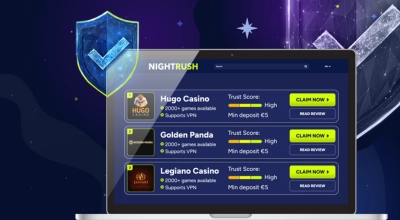
Once we have ascertained which casinos are safe and reliable, we rank them on a spectrum of factors, checking for the range of payment methods, withdrawal limits, bonus offers, website UI, game quality, responsible gambling tools, and customer support quality. Each review typically takes our team several days of active testing before a final rating is assigned.
Many German players focus on welcome bonuses when choosing a casino, but in my experience the most important factor is withdrawal speed and customer support responsiveness. A casino that processes withdrawals within 24 hours and responds to queries within an hour is worth far more than one offering a larger but harder-to-claim bonus.
Popular Online Casino Games for German Players
German online casinos offer a diverse selection of games, though the regulatory framework under GGL rules shapes which games are available. Here is what our team found most popular among German players during our reviews:

Online slot games are the most popular form of gambling in Germany, both at online casinos and real-world locations. Simple mechanics, free bonus spins, high RTP rates typically ranging from 95% to 97%, and the GGL-mandated €1 maximum stake make slots accessible to a wide range of players. In our testing, HTML5-based slot games delivered the smoothest experience across both desktop and mobile devices.German players tend to favour Book of Ra-style slots, fruit machines, and modern video slots with bonus features, especially titles with free spins, expanding wilds, and Hold & Win mechanics.

As live dealer games are prohibited under GGL rules, Random Number Generator (RNG) versions of Roulette, Blackjack, and Baccarat have become the primary way German players enjoy table games online. In our experience, RNG table games offer a fair and consistent experience, with provably fair algorithms ensuring unbiased outcomes for every hand or spin.

Poker is one of the most widely played casino games in Germany, with Texas Hold’em and Omaha being the most popular formats. Tournament poker is particularly popular among the 18-35 age group, based on data from the German Gambling Survey 2025. Online poker is specifically regulated under GGL licensing, meaning players can enjoy it at licensed platforms with full regulatory protection. In our testing, poker lobbies at reviewed casinos offered smooth gameplay with reliable tournament structures.

Sports betting has rapidly grown in popularity in Germany, with an estimated 14% of German adults now participating, according to the German Gambling Survey 2025. Football remains the most bet-on sport by a significant margin, followed by tennis and basketball. Many players use accumulator bets, combining multiple matches into a single wager for higher potential returns. Casinos with sports betting are specifically regulated under GGL licensing, offering German players full legal protection when betting at licensed platforms.
Online slot games are the most popular form of gambling in Germany, both at online casinos and real-world locations. Simple mechanics, free bonus spins, high RTP rates typically ranging from 95% to 97%, and the GGL-mandated €1 maximum stake make slots accessible to a wide range of players. In our testing, HTML5-based slot games delivered the smoothest experience across both desktop and mobile devices.German players tend to favour Book of Ra-style slots, fruit machines, and modern video slots with bonus features, especially titles with free spins, expanding wilds, and Hold & Win mechanics.
As live dealer games are prohibited under GGL rules, Random Number Generator (RNG) versions of Roulette, Blackjack, and Baccarat have become the primary way German players enjoy table games online. In our experience, RNG table games offer a fair and consistent experience, with provably fair algorithms ensuring unbiased outcomes for every hand or spin.
Poker is one of the most widely played casino games in Germany, with Texas Hold’em and Omaha being the most popular formats. Tournament poker is particularly popular among the 18-35 age group, based on data from the German Gambling Survey 2025. Online poker is specifically regulated under GGL licensing, meaning players can enjoy it at licensed platforms with full regulatory protection. In our testing, poker lobbies at reviewed casinos offered smooth gameplay with reliable tournament structures.
Sports betting has rapidly grown in popularity in Germany, with an estimated 14% of German adults now participating, according to the German Gambling Survey 2025. Football remains the most bet-on sport by a significant margin, followed by tennis and basketball. Many players use accumulator bets, combining multiple matches into a single wager for higher potential returns. Casinos with sports betting are specifically regulated under GGL licensing, offering German players full legal protection when betting at licensed platforms.
How to Start Playing at Online Casinos from Germany
Under the supervision of the GGL, gambling online has become safer and more systematic than before. While these responsible gambling policies have added new requirements and steps to ensure fair gaming, the registration process itself is straightforward. Here are the four steps our team recommends to get started safely.
Choose a Licensed Casino and Check the Terms
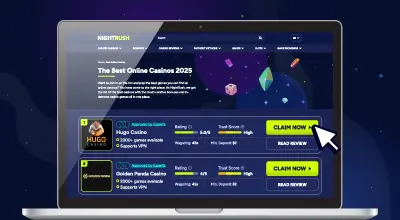
Look for top German casinos that hold a licence from the GGL for full legal protection in Germany or a reputable international licence such as MGA, and verify this on their official site. We have a curated list of the top online casinos with proper licensing. Compare the licensed casinos to find an option that offers welcome bonuses to your liking and does not have any unfair terms or requirements, paying particular attention to wagering requirements and withdrawal caps. In our experience, unfair bonus terms are the most common issue players overlook at this stage.
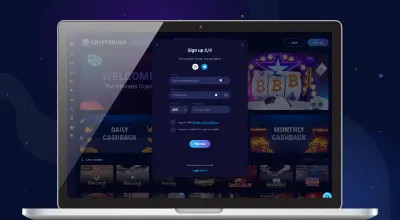
Register and Verify Your Account
Once you have found an ideal casino, click on the sign-up button. Here you will then need to fill in your personal details like your name, address, and date of birth, as required by German regulations. In Germany, online casinos must verify the age and personal identification of every user before they are allowed to deposit or play anything. For this, you will need to upload official documents like your passport or personal ID. Most platforms complete verification within 24 to 72 hours, though some now offer real-time verification through services like IDnow.
Set Deposit and Time Limits
Before you can start playing, German regulations require you to define your responsible gambling settings. You will be prompted to set a monthly deposit limit, capped at a legal maximum of €1,000, as well as session duration limits. In our experience, taking time to set these limits thoughtfully at the start, rather than rushing through them, is one of the most important steps a German player can take for long-term responsible gambling.

Make Your First Deposit and Start Playing
Select your preferred payment method under the payments section. Popular options for German players include Trustly, Sofort, credit and debit cards, and PayPal. The transactions are processed in Euros and are secured with high encryption standards. With this, you are ready to explore the game selection and start playing.
Before registering at any German online casino, prepare your Personalausweis or Reisepass and a proof of address dated within the last 3 months. Having these ready before you start the registration process can reduce verification time from 72 hours to under 10 minutes on platforms using automated IDnow verification.
Common Banking Options at Online Casinos in Germany
German players can choose from a range of trusted and traceable payment methods to fund their online gambling accounts. Under GGL rules, transactions need to be fully identifiable and compliant with spending limits. Based on our testing and research, here are the most widely used and reliable payment methods for German players.
Instant Bank Transfers
Players can deposit money using bank transfers at online casinos or using Sofort directly from your existing bank account without needing to create a separate e-wallet. This method is widely used for securely transferring funds, as it is based on strong German banking protocols. Deposits are typically instant, while withdrawals process within 24 hours in our experience with online casinos.
Trustly
Trustly casinos allow real-time transfers linked to the player’s German bank account with quick deposits and withdrawals. Trustly payment method also offers a ‘Pay N Play’ option which integrates the deposit, player verification and account creation processes into a single streamlined experience, allowing new players to start playing almost immediately without a lengthy registration process. Trustly withdrawals are typically instant or within a few hours.
Credit and Debit Cards
Deposits and withdrawals with traditional cards like Mastercard and Visa at online casinos are widely accepted in Germany, as long as the card is registered to a verified German account. While deposits are instant, withdrawals typically take 3-5 business days.
SEPA Bank Transfers
In case of large withdrawals or deposits above €500, standard Euro bank transfers can be used. Note that SEPA transfers still remain subject to Germany’s €1,000 monthly deposit limit regardless of transfer size. SEPA transfers typically take 2-5 business days to process.
E-Wallets
Cryptocurrencies
GGL-licensed casinos do not accept cryptocurrencies, as anonymous or untraceable payment methods are prohibited under GGL rules. All payment methods must be fully identifiable to comply with the €1,000 monthly deposit tracking requirement. In our experience reviewing German casinos, players occasionally ask about cryptocurrency options. We always recommend sticking to traceable payment methods to ensure full legal protection.
Fastest Withdrawal Method
Based on our testing across dozens of German online gaming platform reviews, Trustly consistently delivers the fastest withdrawal times, often within minutes. If fast access to your winnings is a priority, choosing a casino that supports Trustly as a primary withdrawal method is our strongest recommendation.
Are Online Gambling Winnings Taxed in Germany?
Under the current German legal framework, players are not required to pay any taxes on their winnings from regulated platforms. The sole responsibility of taxation rests on the shoulders of the online casino operators.
Licensed operators must pay a 5.3% tax on every wager placed, which is built into the overall casino operation costs. As a result, players receive their full winnings in their casino accounts and are not expected to declare them in their income tax filings.
Players who use unlicensed platforms risk losing legal protections, including the tax-free status on winnings. Tax authorities may scrutinise large withdrawals from unlicensed sites, and players may be unable to provide adequate documentation in such cases. So, keeping taxation documentation on the right note is important, as with a lack of them, players will no longer get the same protection offered by licensed online casinos within Germany.
In conclusion, if players stick to licensed German casino websites, they can claim tax-free winnings at online casinos and participate in a well-regulated system. It is worth noting that professional gamblers may be treated differently under German tax law, with winnings potentially classified as taxable income. If you gamble regularly at high stakes, consulting a tax professional is advisable.
Documentation Advice
Even though casual gambling winnings are tax-free in Germany, we recommend keeping basic records of your deposits and withdrawals. In our experience, having a simple transaction history can be invaluable if your bank ever queries large incoming transfers from casino platforms.
KYC Requirements for German Online Casino Players
Under the GlüStV 2021, Know Your Customer (KYC) verification is mandatory for all players registering at licensed online casinos in order to ensure transparency in payments and fair gaming and to enable monthly caps on players. Casino operators are legally required to verify each player’s identity, age and residential address when they sign up, before they are allowed to deposit funds or start playing. However, it’s essential to ensure that the casino is properly licensed and has a solid reputation before depositing any money.

To register, German players need to submit an accepted form of ID. Some of the popular forms of ID that can be used include Personalausweis (national ID card), Reisepass (passport) or EU driving licence, but some platforms require that the licence should be complemented by a secondary document such as a recent utility bill or bank statement.

The next step is to verify your proof of residence to show that you are registering in Germany. To confirm your residency, you can provide one of the following, preferably dated within the last 3 months, such as a utility bill, bank statement or an official government correspondence like a tax letter or an Anmeldebestätigung (registration certificate).

The identity verification process usually takes 24 to 72 hours, although some platforms have started offering automated real-time verification using services like IDnow or Schufa. Once this stage is complete, players can start depositing funds and begin playing. In our experience reviewing German casinos, platforms offering automated verification through IDnow completed the process in under 10 minutes in most cases.
To register, German players need to submit an accepted form of ID. Some of the popular forms of ID that can be used include Personalausweis (national ID card), Reisepass (passport) or EU driving licence, but some platforms require that the licence should be complemented by a secondary document such as a recent utility bill or bank statement.
The next step is to verify your proof of residence to show that you are registering in Germany. To confirm your residency, you can provide one of the following, preferably dated within the last 3 months, such as a utility bill, bank statement or an official government correspondence like a tax letter or an Anmeldebestätigung (registration certificate).
The identity verification process usually takes 24 to 72 hours, although some platforms have started offering automated real-time verification using services like IDnow or Schufa. Once this stage is complete, players can start depositing funds and begin playing. In our experience reviewing German casinos, platforms offering automated verification through IDnow completed the process in under 10 minutes in most cases.
Comparing Land-Based and Online Casinos in Germany
Traditional land-based casinos have historically dominated gambling in Germany, though online casinos have been rapidly closing the gap. Whether you prefer the atmosphere of a physical casino or the convenience of playing from home, the right choice depends on your priorities. Having reviewed both options extensively, our team has outlined the key differences below to help you decide.
How to Check a Casino's GGL Licence
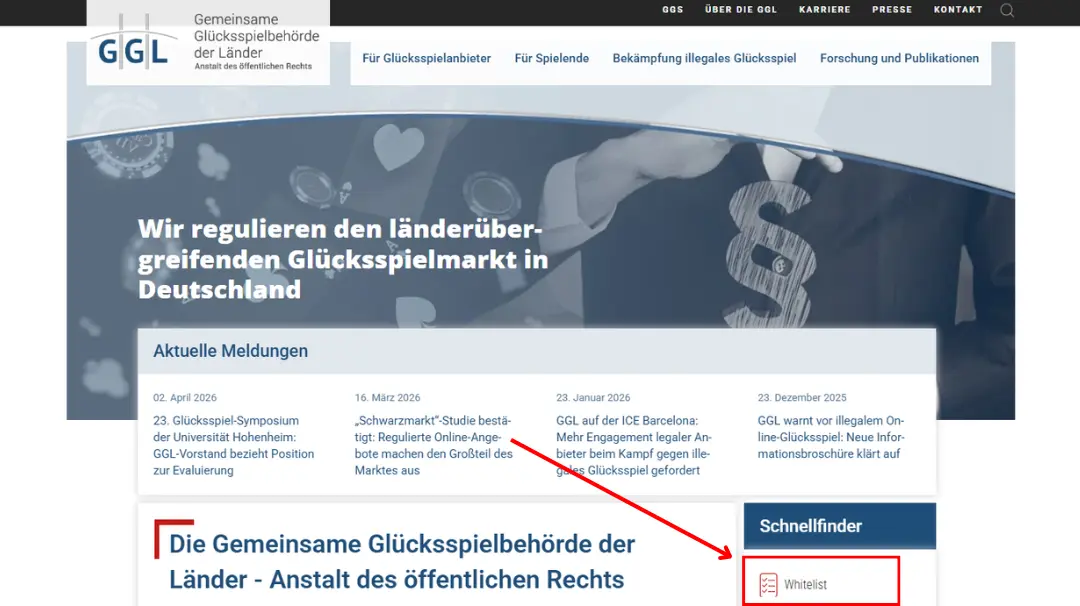
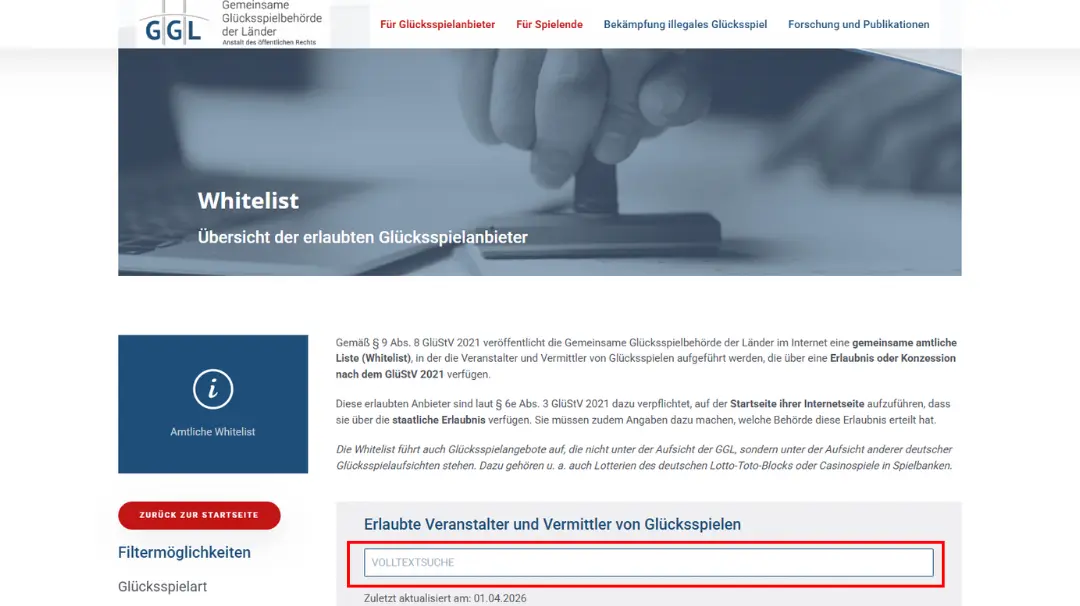
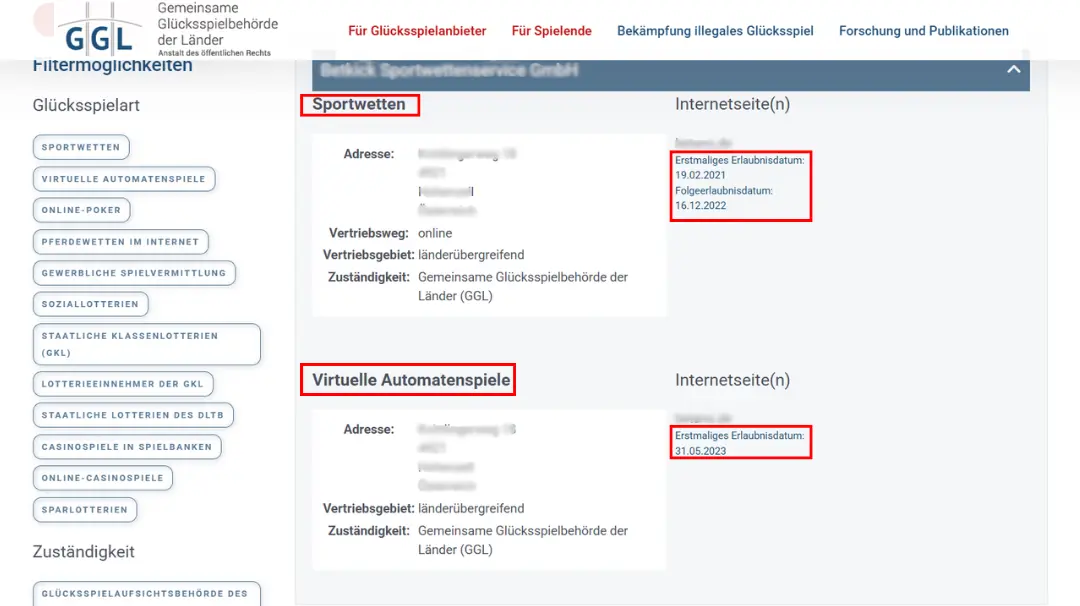
The GGL maintains a publicly accessible licence register, allowing players to verify whether an online casino is legally authorised to operate in Germany. Here is how to check:
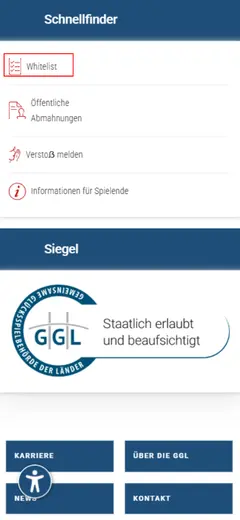
- Visit the official GGL website. Go to gluecksspiel-behoerde.de and navigate to the ‘Whitelist’ section.
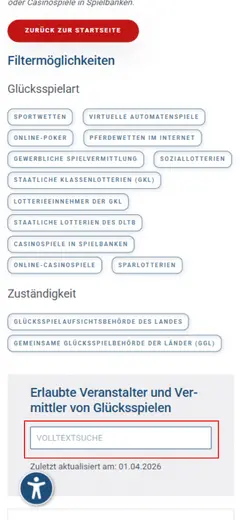
- Search for the casino. Enter the casino’s name or website URL in the search field.
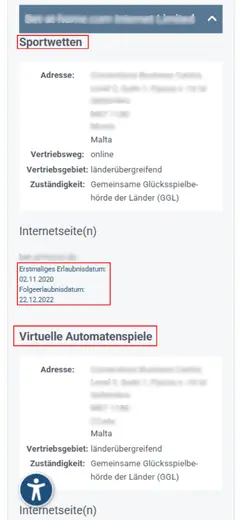
- Check the licence status. A valid entry will show the operator’s name, licence number, issue date, and expiry date.
- Check the licence scope. Confirm whether the licence covers slots, poker, or sports betting, as operators may hold licences for specific products only.
Responsible Gambling Resources in Germany
While online gambling can be an enjoyable form of entertainment, it carries real risks if not managed responsibly. The German Gambling Survey 2025 estimates that about 2.3% of adults, or roughly 1.3 million people in the country, have a gambling disorder. It is crucial that you gamble within your means and within the limits of German law.
In order to protect yourself, you should employ a combination of setting strict personal limits and the responsible gambling tools like deposit caps, reality checks and session timeouts offered by licensed online casinos. For German players, the monthly cap of €1,000 and the restrictions on live games are mandatorily enforced, which significantly reduces the risk of problematic gambling behaviour.
- Beyond these, there are some pre-emptive steps you can personally take, like:
- Take regular breaks during gambling sessions.
- Keep your gambling budget completely separate from daily finances.
- Never gamble under the influence of alcohol or stress.
- Set a time limit before each session and stick to it.
- Never chase losses. If you have reached your limit for the session, stop playing.
Finally, if you or someone you know is starting to struggle with gambling, professional help is readily available. A free helpline is run by the Federal Centre for Health Education (BZgA) for anyone concerned about gambling – visit check-dein-spiel.de to know more. To connect with a counsellor from the Professional Association for Gambling Addiction, players can also call 0800 0776611. German players can also self-exclude nationally through the OASIS register, which bars access to all licensed gambling platforms simultaneously.
You don’t need to be struggling with gambling addiction to use the OASIS self-exclusion register. Many responsible players use it as a planned break tool, registering for a temporary exclusion period during busy life periods like work deadlines or financial stress. In my experience reviewing responsible gambling tools, OASIS is one of the most underused but most effective player protection tools available in Germany.
Final Thoughts on Online Casinos in Germany
Germany operates one of Europe’s most strictly regulated online gambling markets, having a well-established online gambling industry regulated under the 2021 State Treaty, offering legitimate casino, poker, and sports betting options to adult players. These laws also added restrictions, including deposit limits, session timeouts, and bans on anonymous payment methods like cryptocurrencies. The GGL oversees licensing and enforcement to shift gambling from unlicensed sites to compliant platforms.
German gamblers must complete KYC checks and are subject to a €1,000 monthly deposit limit. Winnings from GGL-licensed platforms are tax-free for casual players, with operators bearing the 5.3% tax burden instead. By reading our reviews, choosing properly licensed platforms, verifying licence status on the GGL whitelist, and using the responsible gambling tools available, German players can enjoy a safe and well-regulated gambling experience. Germany’s regulatory landscape continues to evolve, with ongoing debates around live dealer games and deposit limits. We recommend checking back regularly for updates.
FAQs: Online Casinos in Germany
Is Online Gambling Legal in Germany?
Not only is online gambling legal in Germany, but it is also strictly regulated by the Gemeinsame Glücksspielbehörde der Länder (GGL). German players can play at GGL-licensed platforms with full legal protection or at internationally licensed casinos, though the latter falls outside Germany’s regulated framework.
What Are the Requirements for Online Gambling in Germany?
Players must be at least 18 years of age and must be physically located in Germany, which is verified through IP checks and KYC documentation, and they need to complete the KYC process by providing personal details, proof of identity and proof of address in order to register with licensed online casinos in Germany. Using a VPN to bypass location verification violates the casino’s terms and can result in account closure and forfeiture of winnings.
What Types of Online Gambling Are Allowed?
Online German casinos offer a wide range of slots, instant games, poker and software-based table games like blackjack and baccarat. Sports betting is also permitted and specifically regulated under GGL licensing. On the other hand, live dealer games and progressive jackpots are currently prohibited under German law.
What Payment Methods Can I Use?
Licensed online German casinos support many secure methods of digital payments, such as instant bank transfers (Sofort, Trustly), credit and debit cards (Visa/Mastercard), SEPA payments for large transfers, and e-wallets (PayPal, Skrill, Neteller). Cryptocurrencies are not accepted due to legal norms requiring trackable and transparent payment methods.
Are My Winnings Taxed?
For the majority of casual players, no income tax is due on gambling winnings. German tax law considers any winnings earned during ordinary gambling as tax-free income. Professional gamblers may have winnings classified as taxable income and should seek advice from a tax professional.
What Responsible Gambling Tools Are Available?
All licensed iGaming sites in Germany must follow strict regulations to promote safe gambling. Players can set deposit limits and session timeouts, use session timeouts, or self-exclude via the OASIS national exclusion register. The GGL ensures operators comply with these rules.